
Edgar County Projected Versus Actual Release
A projected date is a calculation, not a door-out time. For an IDOC prisoner, the public profile may show a Projected Parole Date. That field estimates departure from confinement under the current sentence calculation. A separate Projected Discharge Date estimates when the whole sentence and supervision relationship should end. If the profile later shows an actual Parole Date and PAROLE status, it supports that prison release occurred and supervision continued.
County custody works differently. A pretrial detainee has no sentence-based release date. A judge may enter a pretrial-release order, but processing and another warrant or detainer may still affect physical departure. A person serving a county-jail sentence may have court-awarded custody credit and a local calculation. The Edgar County Sheriff's release record remains proof of when the person actually left and whether the destination was the community or another agency.
Find Edgar County Projected Release Dates
Start with the committing record. An Edgar County case that sends a person to IDOC should have a judgment and mittimus, the commitment order used by corrections. The state profile then applies IDOC's calculation. A county-only jail term stays with the court and sheriff. Mixing these routes can produce a date from the wrong custody episode.
- Find the Edgar County case number and determine whether the person is pretrial, serving a county term, or committed to IDOC.
- For state prison, open the IDOC Individual in Custody Search and use the IDOC number when possible.
- Match the profile through the birthdate, commitment county, mittimus, physical description, and sentence blocks.
- Read Projected Parole Date and Projected Discharge Date as separate fields. Also note current status and any actual parole date.
- For county jail, obtain the sentencing order and custody-credit finding from the Edgar County Circuit Clerk, then ask the sheriff for the maintained release information.
- For a date that matters, request the current calculation or written event record from the agency responsible for custody.
The Edgar County release lookup covers the sheriff record and court-order confirmation after a jail name disappears. The Sheriff's Office is at 228 N. Central Ave., Paris, IL 61944, and the public jail line is 217-465-4166. No counter hours are published in the research, so confirm access before visiting.
The IDOC search gateway captured from the official source shows where the state lookup begins.
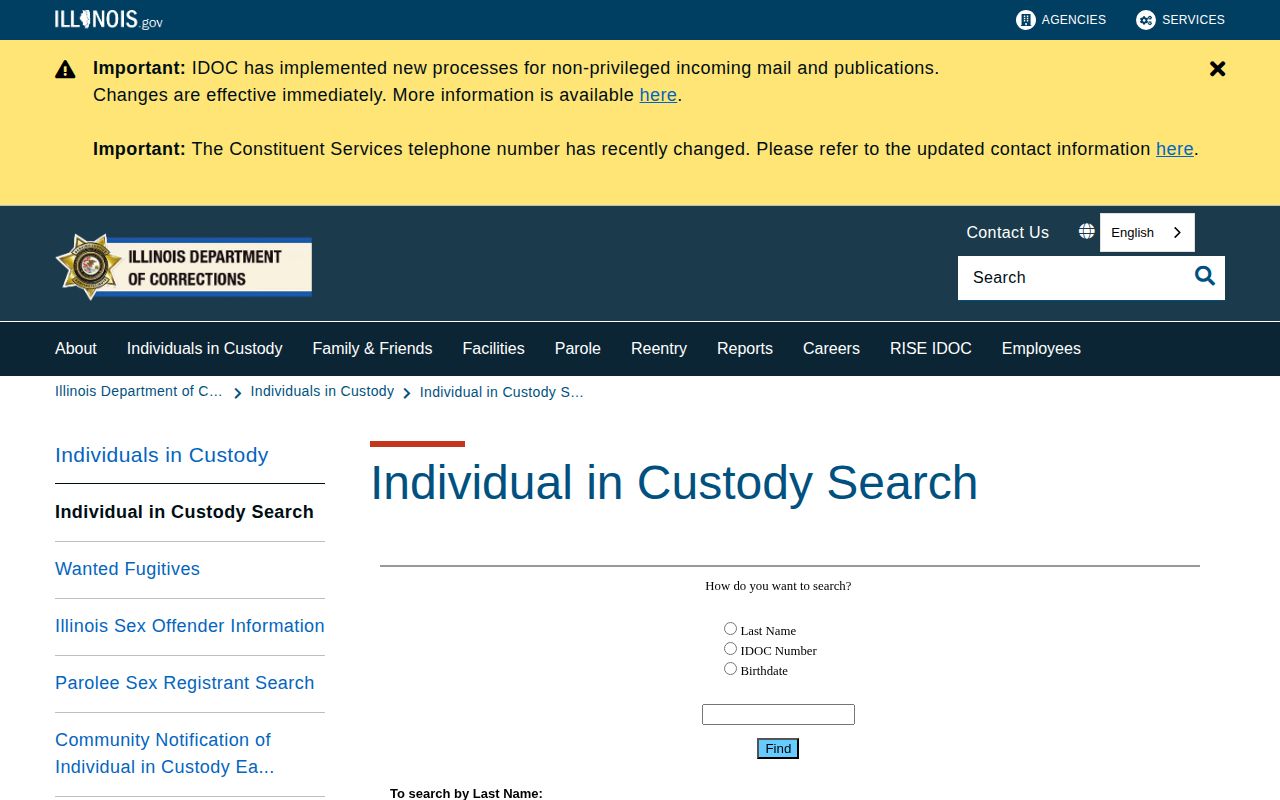
The gateway leads to the live name, IDOC-number, and birthdate routes. Open the full candidate profile before using a date.
Edgar County Sentence Credit Rules
Illinois does not have one “good time” formula for all convictions. 730 ILCS 5/3-6-3 creates offense- and date-specific rules. Some listed first-degree murder and terrorism circumstances require full service. Numerous serious violent, sexual, and firearm offenses allow no more than 4.5 credit days per month, often described as an 85 percent floor. Other listed categories use different limits. Eligible determinate sentences outside exclusions may receive day-for-day statutory credit.
Earned program credit is separate and depends on statutory eligibility, program participation, agency award, offense dates, and minimum service floors. Credit can also be revoked. A sound estimate needs the judgment, mittimus, offense date, sentence, custody-credit award, and IDOC's current calculation. Multiplying a sentence by .85 or .50 ignores facts that can change the answer.
IDOC directive 01.07.400 explains the agency's sentence-calculation process. Consecutive sentences are combined. Concurrent sentences and jail credit depend on correct mittimus treatment. Court amendments can trigger recalculation. Time lost through escape, an MSR violation, or another absence may also affect the projected and mandatory dates. IDOC's FAQ states that an earned-credit revision is communicated to the person and later reflected online.
Why Edgar County Release Dates Change
A projection represents the record at one point in time. Later credit, discipline, a corrected order, another sentence, or a custody hold can change either the calculation or the person's actual destination. The correct response is to date the result and check again near the expected event.
| Factor | Possible effect | Best record |
|---|---|---|
| Statutory or earned credit | May move a projected date earlier within legal limits | Current IDOC profile and calculation |
| Credit loss or absence | May move the date later | IDOC calculation and governing decision |
| Amended court order | Can change sentence terms or custody credit | Certified amended judgment or mittimus |
| Concurrent or consecutive term | Changes how multiple sentences combine | Full sentence blocks and commitment orders |
| Warrant or detainer | May prevent community release despite the end of one term | Facility release or transfer record |
| Parole or MSR action | Can affect supervision, return, or final discharge | IDOC status and PRB record |
A court order may authorize release while jail staff still must process the event. Another authority can take custody at the door. In that case, the accurate statement is release from one facility to another agency, not release to the community.
Confirm Edgar County Release Dates
Illinois VINE can add a person-specific custody-change alert. Search the exact person, confirm the reporting agency, and register from the matched record. Telephone, text, email, or app routes may be offered. A PIN or digital confirmation step may be required. The Edgar County VINELink release check explains the registration path and its limits.
VINE is not final proof. For Edgar County Jail, ask the sheriff for the booking's actual release time, type, destination, and hold disposition. Compare that event with the court order. For IDOC, check the current profile and seek a written calculation when the date is important. A VINE “out of custody” status is an agency-supplied indicator and may reflect a transfer.
Identity matters as much as the date. Match the case or mittimus number and IDOC number where possible. A common name, similar birthdate, or old screenshot can merge separate custody episodes. Preserve the exact label, source, and access date.
Edgar County Parole and Discharge Dates
Illinois profiles make a useful distinction that is easy to miss. Projected Parole Date concerns expected departure from confinement. Projected Discharge Date concerns the expected end of the broader sentence and supervision relationship. Actual Parole Date plus PAROLE status confirms that the prison phase ended while state supervision continued.
Do not read one sentence block in isolation. A profile can list several counts or cases. “Sentence Discharged?: YES” on one block does not prove all other terms ended. Parent Institution can be an administrative field, and a parole-district location points to community supervision rather than incarceration in that office. Review the full profile, including current status and each commitment.
Fully discharged people may disappear from public IDOC search results. A no-result page can also reflect a spelling issue, changed name, wrong birthdate, scope limit, or corrected record. Preserve a lawfully obtained profile, seek written IDOC verification, and check the sentencing court rather than calling no result proof of discharge.
Edgar County Jail Date Calculations
IDOC projections do not govern a person who was never committed to state prison. A county sentence may involve the judge's custody-credit finding and a computation maintained by the sheriff. Pretrial custody has no sentence-driven end date at all. The docket can show a release order, dismissal, time-served judgment, or sentence, but it does not prove the exact time a person walked out.
Ask the Circuit Clerk for the chronological docket, judgment, sentence, mittimus if one exists, and any amended order. Then ask the Edgar County Sheriff's Office for the booking-and-release record. Request the actual release date and time, recorded reason, releasing authority, destination or receiving agency, and detainer disposition. That pair explains both legal authority and physical execution.
A “time served” judgment can support prompt release, yet another case or hold can prevent community departure. Likewise, a state commitment means the county-jail exit is a transfer into IDOC, not the final prison release. State and county dates should be reported as separate events.
Document Edgar County Release Dates
For a durable county record, submit a narrow request through the Edgar County FOIA instructions, naming the person, booking episode, approximate dates, and case number. Ask for existing release fields rather than asking staff to create a fresh calculation. If a field is withheld, request the remainder and the cited exemption. The agency may identify a different maintained record that answers the same event question.
The official Sheriff's Department page provides the jail contact. For IDOC, include the full name, date of birth, IDOC number, and Edgar County mittimus or case number in a focused request. The state search lists 217-558-2200 for public information. The separate number shown in the legacy application for government or law-enforcement use should not be used as a public contact.
When two official dates conflict, report both. Processing, recalculation, data entry, or another hold may explain the difference. Ask the agency that calculated or recorded each date to correct its own record. Do not silently choose the earlier date.