
Edgar County 72-Hour Release Status
No official Edgar County 72-hour release URL was found as of July 16, 2026. The sheriff's public page does not offer a live roster, recent-release archive, refresh schedule, or stated retention window. A three-day list cannot truthfully be copied from a source the county does not publish.
The wider window remains useful as a records question. It catches releases spanning three calendar days and can bridge a weekend, but it must be defined with exact local timestamps. Illinois FOIA contains a 72-hour rule for access to chronologically maintained arrest information. That rule is not a mandate for a public 72-hour release webpage, and it must not be presented as one.
Check Edgar County Three-Day Releases
Choose either a rolling 72 hours ending at a stated time or three full calendar days. Do not mix the two. A range ending at noon differs from a midnight-to-midnight log, and a vague weekend request can omit late Sunday or early Monday processing.
- Write the start and end in Central Time, with dates, times, and the phrase “booking-release events.”
- Call the Edgar County Sheriff's Office at 217-465-4166 to ask what existing log or report contains those events.
- Submit the county FOIA form when a written or durable response is needed.
- Request actual release time, release type, destination or receiving agency, and booking number if maintained.
- Use the court docket and Illinois VINE to confirm each named event without turning either source into a bulk release list.
For a same-day event with a known clock time, Released Last 24 Hours narrows the interval. A precise request reduces false matches and helps staff locate the closest existing record.
Edgar County Three-Day Record Fields
These requested fields describe an ideal event record. They are not a description of a nonexistent online display. The sheriff may keep some data separately, and lawful exemptions or redactions may apply.
| Requested field | Why it matters |
|---|---|
| Name and aliases | Supports identity matching across jail and court records. |
| Booking number | Links the release to one custody episode. |
| Booking date and time | Separates intake from the later exit event. |
| Release date and time | Places the event inside or outside the chosen 72 hours. |
| Release type or reason | Preserves the agency's exact event term. |
| Releasing authority | Points to the related order or legal source. |
| Destination or transfer agency | Distinguishes community release from continued custody. |
Ask for existing records in their maintained form. If no compiled list exists, invite the FOIA officer to identify the releasable daily log or individual entries closest to the request instead of asking the office to conduct new analysis.
Edgar County Weekend Release Timing
A court order, jail release line, and alert can bear different times. The judge's order may authorize release before the jail completes processing. Another warrant or detainer may prevent departure. VINE then depends on the source agency's update. Over a weekend or holiday, those differences can cross a calendar boundary even though they concern one custody episode.
Use the jail timestamp as proof that Edgar County custody ended. Read the destination field before deciding the person entered the community. Use the docket to explain the judicial reason, but do not treat a “time served” entry in one case as proof that every hold cleared. When dates conflict, preserve both and seek clarification from the source offices.
Note: A three-day range improves coverage but does not cure a missing timestamp or an unidentified receiving agency.
Edgar County Multi-Day Fallbacks
The sheriff's record is the first source for county-jail exits. The Edgar County FOIA page gives the formal route. Illinois VINE can show or alert on one person's custody change, while the Edgar County court index can reveal the order, sentence, dismissal, or warrant action that affected the booking. Those tools answer different questions and work best together.
If the jail record says transfer to IDOC, use the Illinois Department of Corrections search after intake processing. A county-only stay may never produce an IDOC profile. Federal convictions belong in the BOP locator, and immigration custody belongs in ICE's locator. The Edgar County release-record overview provides the named-person path when a broad date range is not the real goal.
Why Edgar County Has No Window
The official sheriff page provides no online roster and no past-release archive. It therefore offers no public display period, no cadence, and no way to timestamp a name's disappearance. The 24-hour feed and 72-hour feed were checked independently, and neither was verified.
The Edgar County Sheriff's Department page remains the authoritative public contact gateway. The image below records the official source used in the feed check.
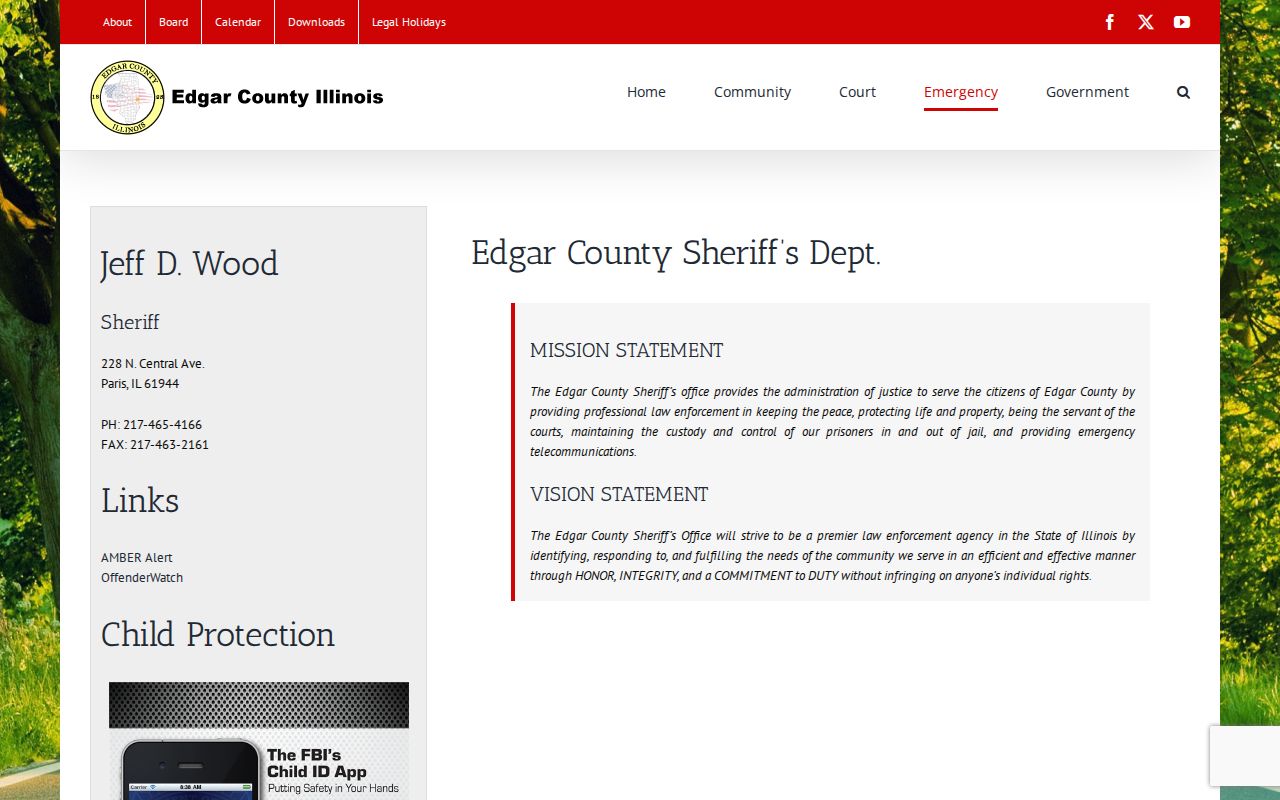
The capture does not prove that a service can never be added. Check the official page again before making a current request, then rely on maintained records if no feed appears.
Read Edgar County Release Terms
A three-day compilation can mix outcomes that should not be grouped as people who “got out.” A pretrial release leaves the case open. A completed county sentence may end custody in that case. A dismissal resolves the identified charge, yet another case can hold the person. Transfer to IDOC closes the Edgar County booking while state confinement continues.
- Release timestamp
- The time Edgar County custody for the booking ended.
- Transfer
- A move to another custodian, not a community release.
- Detainer
- A hold or request from another authority that can prevent release.
- Disposition
- The court's outcome in a case, distinct from the jail's exit record.
Quote the maintained label. Do not replace an unfamiliar term with a more dramatic or simpler one. The reporting agency can clarify its own code when the record does not define it.
Confirm Edgar County Release Records
Begin with identity. Match the full name with a booking number, case number, birth date if lawfully known, or another reliable identifier. A three-day interval may contain more than one booking for the same person, and two people may share a name. Keep uncertain details labeled as uncertain rather than borrowing them from a nearby result.
Next, pair the facility event with its legal authority. The sheriff record establishes when and how the person left Edgar County Jail. The court docket explains whether a pretrial order, dismissal, sentence, or other ruling authorized that movement. If the release line identifies another custodian, continue with that agency instead of stopping at the closed county booking. IDOC, BOP, ICE, and another county each maintain different systems.
Finally, record provenance: the office, record title, case or booking number, access date, and exact status phrase. A VINE notice yields to the source-agency event record. A booking charge yields to the final court disposition. If two official dates conflict, preserve both and ask the offices to explain rather than silently choosing one.
A current-custody check and a historical release check also require different evidence. A current list, if Edgar County later adds one, would answer who the jail reports at that moment. It would not become a permanent archive. The sheriff's event record and court docket remain the durable routes after a name is gone. For state imprisonment, the IDOC profile is the more useful continuing record, though a fully discharged person may eventually return no public match.
Keep the range request separate from a request about one person. A date-range log seeks all maintained events during the defined period. A named-person request seeks one booking episode and can include the release line, releasing authority, destination, detainer disposition, and property acknowledgment. Combining both goals in a vague request can slow identification of the record. If the office says the requested compilation does not exist, narrow the request to the releasable daily log or specified individual entries rather than demanding a new report.